It's 2:15 PM on a Tuesday, and you have back-to-back consultations booked through Friday. The first one is a no-show. The second is a personal injury case — except the incident happened four years ago, well past your state's statute of limitations. The third is a real estate dispute that doesn't match your practice areas at all. By 5 PM, you've spent three hours in meetings that will never generate a dollar of revenue.
This isn't bad luck. It's a lead qualification problem — and it's one that AI chatbot law firm lead qualification solves before the consultation ever gets scheduled. For how AI chatbots work more broadly, see our Complete Guide to AI Chatbots.
Answer Capsule
Law firms use AI chatbots to qualify leads by automating the intake conversation on their website. When a visitor describes their legal issue, the chatbot asks structured questions about case type, jurisdiction, incident date, and urgency — then routes only qualified prospects to the calendar. This eliminates consultations with out-of-jurisdiction cases, expired claims, and practice area mismatches before they ever reach your schedule.
The Hidden Cost of Unqualified Consultations
Most attorneys track billable hours. Few track the non-billable time spent on consultations that never convert.
A solo practitioner spending two hours per week on unqualified intakes loses roughly 100 hours per year — the equivalent of 12 full working days. For a firm billing at $300/hour, that's $30,000 in lost opportunity annually, not counting the mental drain of repeating the same disqualifying conversation over and over.
The problem starts at the top of the funnel. Most law firm websites offer a contact form and a phone number. Both collect inquiries indiscriminately — there's no filter for jurisdiction, case type, or timeline. Every submission, from a viable $50,000 personal injury case to a casual question about a landlord dispute in another state, lands in the same inbox.
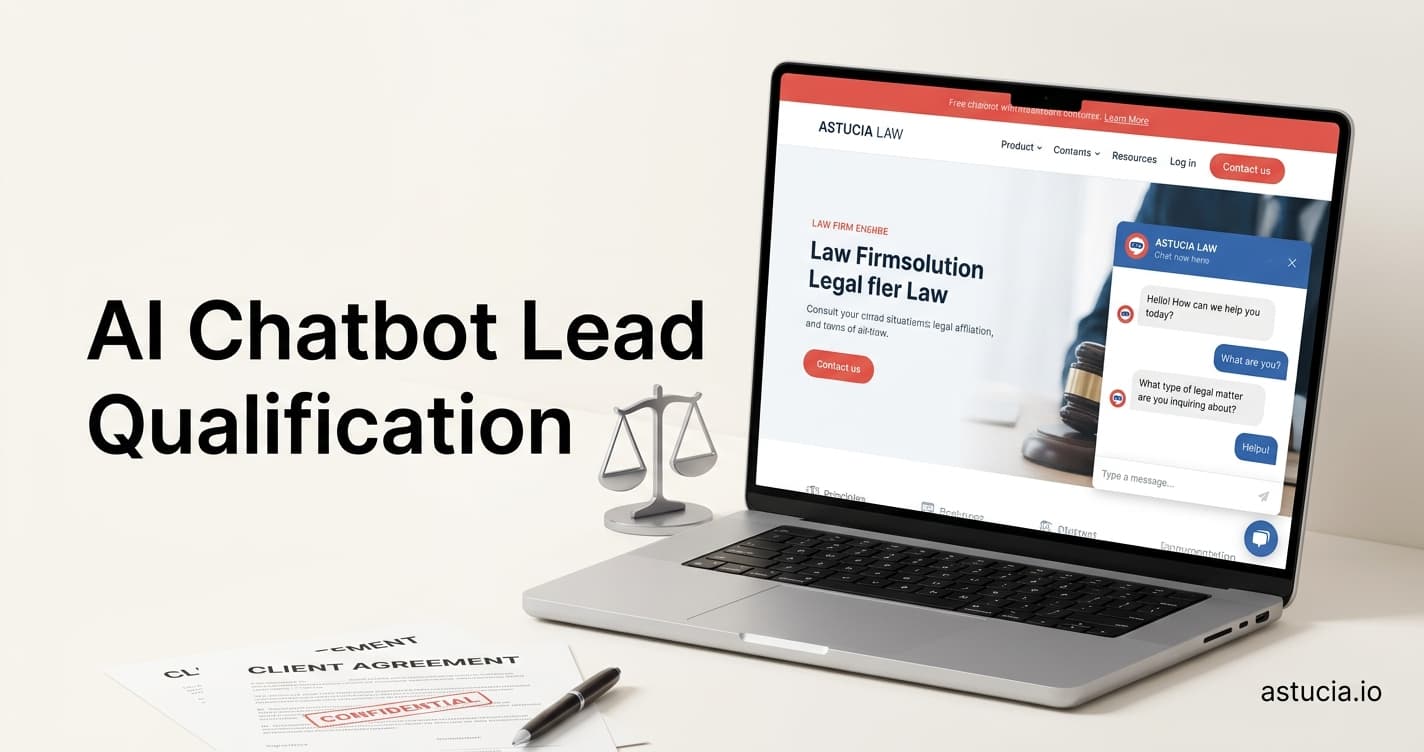
AI chatbot law firm lead qualification changes that. Instead of collecting contact info and following up blind, the chatbot conducts a preliminary intake conversation the moment someone arrives on your site.
Free Resource
Free Lead Audit Checklist
Find the 7 most common reasons your website visitors leave without converting.
Download FreeHow AI Chatbot Lead Qualification Works for Law Firms
The intake conversation looks simple from the visitor's perspective — a few questions, a few clicks. Behind the scenes, it's doing the work your paralegal would otherwise spend 20 minutes doing over the phone.
Here's the flow:
Step 1 — Practice area match. The chatbot asks what type of legal issue the person has. If they select an area outside your practice (say, immigration, when you only handle personal injury), it gracefully refers them to other resources rather than booking a slot on your calendar.
Step 2 — Jurisdiction check. The chatbot asks where the incident occurred or where the client is located. If your firm is licensed in Illinois and the case is in Texas, you find out now — not at the consultation.
Step 3 — Timeline verification. For time-sensitive practice areas, the chatbot captures the incident date and compares it against your state's statute of limitations. A personal injury case from five years ago fails automatically.
Step 4 — Urgency triage. Is there an active court date? An imminent filing deadline? The chatbot flags these cases for immediate follow-up rather than routing them into a standard 3-day callback queue.
Step 5 — Qualification routing. Prospects who pass all filters get a link to book a paid or free consultation. Those who don't are routed to a helpful message, a referral, or a waiting list — without wasting anyone's time.
This entire process happens in under three minutes, at any hour of the day.
Five Questions Your AI Chatbot Should Ask Before the First Call
The quality of your lead qualification depends entirely on the questions you build into the intake flow. Here are the five that move the needle most for law firms:
1. What type of legal matter are you dealing with? This is your practice area filter. Use plain language options (car accident, divorce, business dispute) rather than legal jargon.
2. When did this happen, or when is your deadline? Incident date catches expired claims. Deadline captures urgency that changes how quickly you need to respond.
3. Where did this occur / where do you live? Jurisdiction mismatches are one of the top reasons consultations go nowhere. Catch them here.
4. Have you spoken with any other attorneys about this matter? Clients who have already been rejected elsewhere or are shopping around require a different approach than first-time inquirers.
5. What outcome are you hoping for? This reveals whether the client's expectations are realistic. Someone who wants their landlord "thrown in jail" for a civil dispute signals a mismatch in expectations — better to know that before the consultation.
When you customize these five questions to your practice area and jurisdiction, your AI chatbot law firm lead qualification system does more useful triage in three minutes than most intake calls accomplish in twenty.
What Gets Filtered vs. What Gets Booked
A well-configured chatbot doesn't reject good cases — it just catches the bad ones before they consume your schedule.
Cases that get filtered:
- Personal injury claims past the statute of limitations
- Out-of-state matters where you're not licensed
- Practice area mismatches (calling a family law firm about a contract dispute)
- Inquiries looking for free legal advice rather than representation
- Cases with no damages worth pursuing (small claims territory)
Cases that get booked:
- Personal injury cases within the limitations window, in your jurisdiction, with quantifiable damages
- Divorce or custody matters in your state, with realistic expectations
- Business disputes with a clear cause of action and a client who has the budget to litigate
The difference isn't just efficiency — it's mental clarity. Walking into a consultation where you already know the jurisdiction, the case type, the incident date, and the client's expectations transforms the meeting from a screening call into a real conversation about how you can help.
AI Intake vs. a Contact Form: The Real Difference
A contact form collects data. An AI chatbot qualifies a prospect.
Here's what that distinction looks like in practice:
| Contact Form | AI Chatbot Intake | |
|---|---|---|
| Information collected | Name, email, "brief description" | Case type, jurisdiction, date, urgency, expectations |
| Qualification | None — you decide on callback | Automated — only qualified leads reach your calendar |
| Response time | Next business day (or longer) | Immediate — 24/7 |
| Appointment booking | Manual follow-up required | Direct booking link for qualified prospects |
| Out-of-hours coverage | Inquiry waits in inbox | Full intake completed while you sleep |
The contact form was designed for a world where every website visitor was worth calling back. In a high-volume legal market, that assumption costs attorneys thousands of hours per year.
A Note on Compliance and Client Sensitivity
AI chatbots for law firms are not giving legal advice — they're collecting information. The distinction matters for bar compliance, and any chatbot you deploy should include a clear disclaimer that the conversation does not create an attorney-client relationship.
For emotionally sensitive practice areas (family law, criminal defense, immigration), the chatbot's tone matters as much as its questions. Train it to acknowledge the difficulty of the situation before asking about logistics. "I understand this is a stressful situation — I just need to ask a few quick questions to connect you with the right attorney" lands differently than a cold intake form.
Done right, AI chatbot law firm lead qualification doesn't feel like a filter to clients — it feels like fast, responsive service. They get answers immediately, and they get connected to the right person faster than they would through a phone queue.
If your firm also needs to handle after-hours phone calls — not just website inquiries — see how an AI receptionist for law firms can cover that gap around the clock.
Keep Reading
- AI Receptionist vs. Answering Service: Which Is Better for Your Firm? — Compare the options for handling inbound calls
- How to Stop Losing Leads to Your Contact Form — Why contact forms have a conversion problem, and how to fix it
- AI Customer Service for Small Business in 2026 — The full picture of automating client-facing communication
Ready to stop spending consultations screening cases that should have been filtered at intake? See how Astucia's AI chatbot works for professional services firms — setup takes less than a week.